
Last updated: 25 November 2026. We checked every rule and figure against GOV.UK on this date.
A Section 8 notice is now the only way to start ending a private tenancy in England. Since the Renters' Rights Act scrapped Section 21 on 1 May 2026, every London landlord who needs a property back must use one. This guide explains every ground, the notice periods, how to serve Form 3A and what happens next.
We are Homefinders, a family-run letting agent on Kingsland High Street in Dalston. We have managed rented homes across Hackney and East London since 1988. So we see how a small mistake on a Section 8 notice can cost a landlord months. Here is what you need to know, in plain English. For the wider changes, read our guide to the Renters' Rights Act 2025.
Need help with a Section 8 notice?
Our lettings team can check your grounds, dates and paperwork before you serve. Book a free call with our Lettings Director, Melissa Sehri.
What is a Section 8 notice?
The name refers to section 8 of the Housing Act 1988. It is the formal first step a landlord must take to get a property back from a tenant on an assured tenancy. You may also see it called a notice seeking possession or a Section 8 eviction notice.
Also, do not confuse it with a Section 13 notice. That one is for raising the rent, as our guide to increasing rent in 2026 explains.
However, serving it does not bring the tenancy to an end. Instead, it tells your tenant why you want the property back and the earliest date you can go to court. If the tenant stays after that date, you then apply to the county court for a possession order.

What changed for Section 8 notices on 1 May 2026?
The Renters' Rights Act 2025 rewrote the rules. These are the changes that matter most:
- Section 21 has gone, so you now need a legal reason, called a ground, to end a tenancy.
- Form 3A is now the only notice form for private landlords, while social landlords keep the old Form 3.
- New grounds arrived, including Ground 1A for selling and Ground 4A for student HMOs.
- Many notice periods are longer. For example, rent arrears now need four weeks, up from two.
- Councils can now fine landlords up to £40,000 for misusing a ground.
If you have more questions about the new rules, our guide to the five biggest landlord worries answers the ones we hear most.
Section 8 notice grounds: the full list for private landlords
The grounds are the legal reasons you can rely on. The Housing Act 1988 lists them in Schedule 2, and you must name at least one on your notice. Also, each ground is either mandatory or discretionary:
- Mandatory grounds. Prove the ground, and the court has to grant possession.
- Discretionary grounds. Here, proving the ground is not enough on its own. The judge also weighs up whether eviction is fair.
The table shows the grounds private landlords use most, with the minimum notice for each one. It follows GOV.UK's grounds for possession guidance.
| Ground | What it covers | Minimum notice | Type |
|---|---|---|---|
| 1 | You or close family want to move in | 4 months | Mandatory |
| 1A | You want to sell the property | 4 months | Mandatory |
| 2 | Your lender wants to repossess | 4 months | Mandatory |
| 4A | Student HMO needed for new students | 4 months | Mandatory |
| 6 | Major works or redevelopment | 4 months | Mandatory |
| 6B | Complying with council enforcement action | 4 months | Mandatory |
| 7 | Death of the tenant (some cases) | 2 months | Mandatory |
| 7A | Serious antisocial or criminal behaviour | None | Mandatory |
| 7B | Tenant has no right to rent | 2 weeks | Mandatory |
| 8 | At least 3 months' rent arrears | 4 weeks | Mandatory |
| 9 | Suitable other home offered | 2 months | Discretionary |
| 10 | Any rent arrears | 4 weeks | Discretionary |
| 11 | Persistent late payment | 4 weeks | Discretionary |
| 12 | Breach of the tenancy agreement | 2 weeks | Discretionary |
| 13 | Damage to the property | 2 weeks | Discretionary |
| 14 | Nuisance, annoyance or crime | None | Discretionary |
| 15 | Damage to furniture | 2 weeks | Discretionary |
| 17 | False statement to get the tenancy | 2 weeks | Discretionary |
Source: GOV.UK, Grounds for possession: guidance for landlords and letting agents, checked 25 November 2026. For Grounds 7A and 14, you can apply to court straight away, but the court waits 14 days before making an order.
Ground 1 and Ground 1A: moving in or selling
These are the grounds landlords ask us about most. Both need four months' notice. Also, you cannot use them to take the property back during the first year of a tenancy. You can serve the notice earlier, but it must not end before the tenancy is 12 months old.
There is a catch, though. Once you use Ground 1 or 1A, you cannot let the property again for 12 months after the notice ends, according to the NRLA. So only use them if you really plan to move in or sell. Our guide to selling a tenanted property in London covers Ground 1A in full.
Grounds 8, 10 and 11: rent arrears
Ground 8 is mandatory, but it is now harder to use. Your tenant must owe at least three months' rent, or 13 weeks if they pay weekly. They must owe that amount both when you serve the notice and on the day of the hearing. Also, arrears caused only by a late Universal Credit payment do not count.
That is why most landlords use Grounds 8, 10 and 11 together. If the tenant pays some of the debt before court, the claim can still succeed on the discretionary grounds. Our guide to rent arrears for London landlords explains what to do before you serve.
Grounds 12, 13 and 14: breach, damage and antisocial behaviour
Ground 12 is for when a tenant breaks the tenancy agreement in a way that is not about rent. Subletting without your permission is a common example. Ground 13, meanwhile, covers damage to the property. Both are discretionary, and both need two weeks' notice.
For antisocial behaviour, Ground 14 lets you apply to court straight after you serve the notice. Ground 7A does the same for serious crime or a breached court order. However, the court cannot make a possession order until 14 days after you served notice.
Section 8 notice periods at a glance
The notice period is the minimum time between serving your notice and applying to court. It depends on the grounds you use, as this table shows.
| Minimum notice | Grounds |
|---|---|
| None (court waits 14 days) | 7A and 14 (antisocial behaviour) |
| 2 weeks | 7B, 12, 13, 15 and 17 |
| 4 weeks | 8, 10 and 11 (rent arrears) |
| 2 months | 7 and 9 |
| 4 months | 1, 1A, 2, 4A, 6 and 6B |
Using several grounds on one notice? Then the whole notice must give the longest period among them. So if you combine rent arrears (four weeks) with a breach of tenancy (two weeks), you give four weeks. Antisocial behaviour is the exception, because you can still go to court straight away.
How long is a Section 8 notice valid for?
You must apply to court within 12 months of the date you served your Section 8 notice, according to the NRLA. After that, the notice expires. Then you have to serve a new one and wait all over again.
How to serve a Section 8 notice on Form 3A
A valid notice gets you to court. An invalid one sends you back to the start, so follow these steps carefully. GOV.UK also publishes Form 3A guidance for landlords.
- Check your paperwork first. With most grounds, a judge will refuse possession unless you protected the deposit in a government-approved scheme and gave the tenant the prescribed information. Once the new PRS Database opens, you will also need to register on it.
- Choose the right grounds. Pick the grounds that match your situation, and make sure you can prove them. In fact, using a ground you cannot prove can lead to a fine.
- Download the current Form 3A. Get it free from the assured tenancy forms page on GOV.UK. Never use the old Form 3 or a template from another website.
- Copy in the full legal wording. For each ground, copy the exact text from Form 3A: legal wording for possession grounds into question 4.2 of the form.
- Explain your reasons. Set out clearly why each ground applies. For rent arrears, for instance, attach a rent statement showing what your tenant owes.
- Name every tenant. Include every adult named on the tenancy agreement, and give each one a copy.
- Set the right date. Work out the first date on which you could go to court. Then add a few extra days for delivery, so you never give too little notice.
- Serve it and keep proof. Hand it over or post it, using a method your tenancy agreement allows. Next, keep a copy and note the date and method you used. Form N215, the certificate of service, is a simple way to do this.
Can I serve a Section 8 notice myself?
Yes. You do not need a solicitor or an agent to serve a Section 8 notice. However, the court can dismiss your claim if the notice has errors. So many landlords ask an agent or solicitor to check it first. If we manage your property, our team handles this for you.
Can a Section 8 notice be served by email?
Only if your tenancy agreement says notices can go by email. If it does not, deliver the notice by hand or by post. In fact, many landlords use two methods, just to be safe.
Common Section 8 notice mistakes
Most failed claims come down to a handful of avoidable errors. In our experience, these are the ones that catch London landlords out most often. Our Renters' Rights checklist for landlords helps you avoid them.
- Filling in an outdated template, or the social housing Form 3, rather than Form 3A.
- Giving too little notice, or forgetting that the longest ground sets the period.
- Leaving the deposit unprotected, or missing the prescribed information.
- Writing the ground number but not its full legal wording.
- Missing a tenant's name, or serving only one of two joint tenants.
- Relying on Ground 8 when the arrears are just under three months.
- Applying to court more than 12 months after serving the notice.
Above all, never change the locks, cut off utilities or pressure a tenant to leave. That is illegal eviction, and councils can fine you up to £40,000 for it.
What happens after a Section 8 notice expires?
If your tenant leaves by the date in the notice, the tenancy ends there. If not, you need a possession order from the county court. Here is how the process works, based on GOV.UK's guide to repossessing your property.
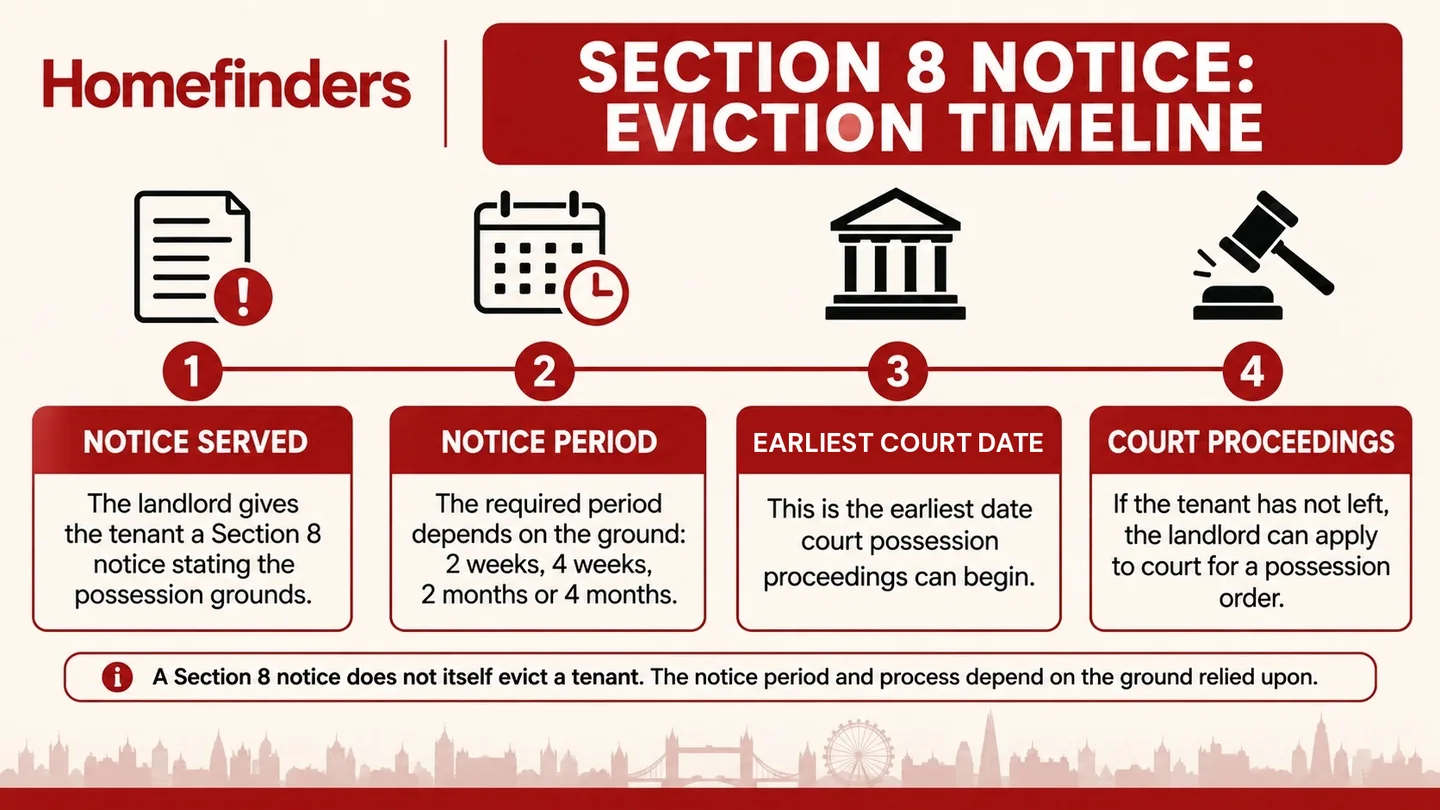
Apply to the county court
If you are claiming for rent arrears only, you can apply online through Possession Claim Online. For any other ground, you fill in paper forms N5 and N119 and send them to your local county court. A paper claim costs £415. Also, you must include a copy of your Section 8 notice.
The possession hearing
The court sends the claim to your tenant, who then has 14 days to file a defence. Next, the court sets a hearing date. At the hearing, you need evidence for each ground, such as a rent statement, photos of damage or proof that you have asked an estate agent to sell.
Possession orders and bailiffs
On a mandatory ground, the judge usually orders the tenant to leave within 14 days. However, the judge can allow up to six weeks if leaving sooner would cause extreme hardship. On a discretionary ground, the judge may instead make a suspended order, with conditions such as paying off the arrears.
If the tenant still does not leave, you apply for a warrant of possession, which costs £148. County court bailiffs then give the tenant at least 14 days' notice of the eviction date. You can also ask to transfer it to the High Court, where enforcement is usually quicker, though it costs more.
How long does a Section 8 eviction take in London?
Longer than most landlords expect. Figures from the Ministry of Justice for July to September 2026 show a median of 25.9 weeks from a landlord's court claim to repossession. That is around six months, and it comes on top of your notice period.
| Stage | Median time (England, Q3 2026) |
|---|---|
| Court claim to possession order | 7.7 weeks |
| Court claim to warrant | 15.0 weeks |
| Warrant to repossession | 9.1 weeks |
| Court claim to repossession | 25.9 weeks |
London courts are especially busy. In fact, they handled 9,483 landlord claims in that quarter, about a third of the total for England. That was 21% more than a year earlier, after the Renters' Rights Act came in.
So add it up. With four months' notice on Ground 1A, then around six months in court, getting a property back could take close to a year. That is why planning early really matters.
Section 8 notice penalties for landlords
The new law gave councils extra powers to fine landlords who misuse the process. According to the NRLA, the penalties work like this:
- Up to £7,000 for relying on a ground you do not reasonably believe applies, or for trying to end a tenancy without a valid Section 8 notice.
- Up to £40,000 for knowingly or recklessly misusing a ground, or for illegal eviction or harassment.
- Rent repayment orders, which let tenants claim back rent they paid you.
On top of that, there is the 12-month ban on re-letting after Grounds 1 and 1A. So keep evidence of your plans, such as your instructions to an estate agent. Our guide to landlord licensing in London also covers the separate fines for unlicensed lets, including Hackney's licensing schemes.
A Section 8 notice example from Hackney
Here is a simple illustration, based on the average Hackney rent. It is not a real case, but it shows how quickly the costs build up.
The average private rent in Hackney was £2,667 a month in September 2026, according to the ONS. So by the time a tenant owes three months, the arrears reach about £8,000. Only then can the landlord rely on Ground 8.
| Stage | Time | Rent lost |
|---|---|---|
| Arrears reach 3 months | 3 months | About £8,000 |
| Section 8 notice period (Ground 8) | 4 weeks | About £2,500 |
| Court claim to repossession (median) | 25.9 weeks | About £15,900 |
| Total | Around 10 months | About £26,400 |
Then add the £415 court fee and the £148 warrant fee. As a result, the bill comes close to £27,000, before any legal costs. Every case is different, of course, but the lesson is clear.
Acting on the first missed payment matters most. Good referencing, including digital ID checks, also cuts the risk before a tenant moves in. That is also why many landlords choose a managed service with rent protection, as our guide to let only vs fully managed explains.
Section 8 notice vs Section 21: what is the difference?
Section 21 let landlords end a tenancy without giving a reason. A Section 8 notice, by contrast, always needs a ground that you can prove in court. The Renters' Rights Act abolished Section 21 for private tenancies in England on 1 May 2026.
The last chance to use an old Section 21 notice has also passed. Landlords had to start court action by 31 July 2026, according to GOV.UK. So today, a Section 8 notice is the only route for almost every private landlord.
Getting help with a Section 8 notice in London
We have let and managed homes across Hackney and East London since 1988, from our office at 146 Kingsland High Street in Dalston. So we know which paperwork judges check first, and we know how busy London courts are. See all our services for landlords.
If we manage your property, we keep your deposit, certificates and records in order from day one. Our own builders and handymen also deal with repairs quickly, so disputes are less likely. Then, if a problem starts, we act quickly and serve notices correctly. Our Premium Plus package even guarantees your rent and covers eviction costs. Find out more about our letting agents in Hackney, our letting fees and renting out a property in Hackney.
Thinking of selling instead? Our guide on whether to sell your rental property can help you decide.
Worried about a tenancy?
Speak to our Lettings Director, Melissa Sehri, for free, no-obligation advice. Or call us on 020 8533 6461.
Section 8 notice FAQs
These answers cover the questions London landlords ask us most about Section 8.
Section 8 notice basics
What is a Section 8 notice?
It is the official notice landlords in England use to start getting a property back. You fill in Form 3A, give a legal reason called a ground, and allow the right notice period before you can go to court. Since May 2026, it is the only route for private landlords.
What are the grounds for a Section 8 notice?
They are the legal reasons for ending a tenancy, set out in the Housing Act 1988. Landlords rely most on a few: Grounds 1 and 1A to move in or sell, Grounds 8, 10 and 11 for unpaid rent, Ground 12 for a broken agreement, and Grounds 7A and 14 for antisocial behaviour.
Is a Section 8 notice the same as an eviction notice?
Not quite. A Section 8 notice starts the process, but it does not evict anyone by itself. If your tenant stays after the notice ends, you must get a possession order from the court. After that, only court bailiffs or High Court enforcement officers can carry out an eviction.
Can I still use a Section 21 notice?
No. The Renters' Rights Act abolished Section 21 for private tenancies in England on 1 May 2026. Also, the deadline for starting court action on an old Section 21 notice passed on 31 July 2026. So a Section 8 notice is now the only route for private landlords.
Notice periods and serving
How much notice do I need to give on a Section 8 notice?
It depends on the ground. Rent arrears need four weeks, and selling or moving in needs four months. Breach of tenancy needs two weeks, while serious antisocial behaviour needs none. Where you combine grounds, give the longest period of the ones you use, unless one is for antisocial behaviour.
How long is a Section 8 notice valid for?
A Section 8 notice lasts for 12 months from the day you serve it. Within that time, you can apply to court once the notice period ends. After 12 months it lapses, so you would need to serve a fresh notice and then wait for the notice period again.
Can I serve a Section 8 notice myself?
Yes. You do not need a solicitor or agent to serve one. However, the court can dismiss a claim if the notice has errors, and that costs months. So many landlords ask a letting agent or solicitor to check the form, the grounds and the dates before they serve it.
Where do I get a Section 8 notice form?
Download Form 3A for free from the assured tenancy forms page on GOV.UK. You also need the separate document with the legal wording for each ground. Avoid templates from other websites, because an out-of-date form can make your notice invalid and send you back to the start.
Court and eviction
What happens after a Section 8 notice expires?
If your tenant has not left, you apply to the county court for a possession order. For rent arrears only, you can apply online. Otherwise, you use paper forms N5 and N119, and a paper claim costs £415. The court then sends the papers to your tenant and sets a hearing date.
How long does a Section 8 eviction take?
Ministry of Justice figures for July to September 2026 show a median of 25.9 weeks from court claim to repossession in England. On top of that, you have the notice period, from none to four months. So in London, the whole process often takes between six months and a year.
Rent arrears and getting help
How much rent arrears before I can use Ground 8?
Your tenant must owe at least three months' rent, or 13 weeks if they pay weekly or fortnightly. This must be true on the day you serve the notice and again on the hearing day. Also, arrears caused only by a late Universal Credit payment do not count towards the total.
Can a letting agent serve a Section 8 notice for me?
Yes. A letting agent can prepare and serve a Section 8 notice on your behalf, as long as you have authorised them. At Homefinders, we do this for landlords whose homes we manage across Hackney and East London. So book a free landlord advice call to talk through your situation.
Sources, checked on 25 November 2026: GOV.UK grounds for possession, GOV.UK repossession guide, GOV.UK Form 3A, Ministry of Justice, NRLA and ONS. This guide gives general information, not legal advice. Take legal advice before you serve a notice.