
Today is the day. The Renters’ Rights Act 2025 officially comes into force, and with it, the biggest change to the private rented sector in over 30 years.
We know that’s a phrase that gets thrown around a lot. But this time it’s genuinely true. The Housing Act 1988 gave us the Assured Shorthold Tenancy. This Act ends it. The landscape you’ve operated in as a landlord, potentially for decades, changes from today.
We’ve spent months preparing for this, hosting webinars, writing guides and speaking to our landlords one by one. But we know not everyone has had the chance to read everything. So we wanted to write one clear, honest article that covers what you actually need to know, without the legal jargon and without the panic.
Because here’s the truth: if you’re a well-managed, sensible landlord, or if you have a professional agent looking after your property, this is very manageable. It’s different. It requires more care and more process. But it is absolutely manageable.
Please read this in full. There are deadlines in here that matter, and one in particular (31 May) that is coming up very fast.
What has actually changed today?
A lot. All of the following came into effect on 1 May 2026, with no transition period and no opt-out, including for existing tenancies.
- Section 21, the ‘no fault’ eviction, is abolished. Every possession claim must now cite a specific ground under Section 8.
- Every existing Assured Shorthold Tenancy has converted to a periodic (rolling) tenancy automatically, overnight. There are no more fixed terms.
- New fixed-term tenancies cannot be created. All new tenancies must be periodic from day one.
- Tenants can leave with 2 months’ written notice at any point, including from day one of a new tenancy.
- Landlords cannot accept more than 1 month’s rent in advance, even if the tenant offers more.
- All rent increases must be served via a Section 13 notice using Form 4A. Any existing rent review clause in your tenancy agreement is now void.
- Rental bidding is banned, you cannot advertise a rent range or accept offers above the asking price.
- Pet requests cannot be unreasonably refused. You must respond in writing within 28 days.
- Refusing a tenant solely because they have children or because they receive Universal Credit or housing benefit is now unlawful discrimination.
- A new written statement of terms is required for all new tenancies starting from today.
The Act applies to ALL existing tenancies, not just new ones. It doesn’t matter if your tenant has 14 months left on a 24-month fixed term. That tenancy converted to periodic today. There is no grandfather clause.
The dates you need in your diary right now
Some of these have already passed. Some are coming up very soon. Please check all of them against your own situation.
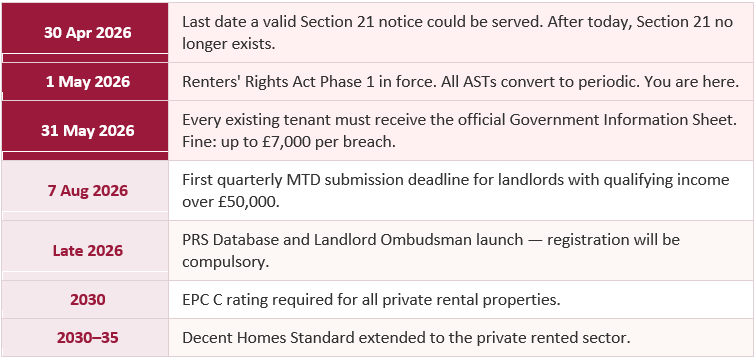
The 31 May deadline is the most urgent thing on this list. You have 30 days to serve the Government Information Sheet on every existing tenant. If you’re with Homefinders, we are doing this for you. If you manage your own property, download the PDF from GOV.UK today and send it as an attachment to every tenant, not a link, the actual PDF.
‘But isn’t this terrible for landlords?’
We hear this a lot. And we understand why. The headlines have been alarming, and we’ve spoken to landlords who are seriously considering selling their entire portfolios because of it.
Our honest view, and we’ve been in this industry for 40 years, is that the anxiety is running ahead of the reality. Here’s why.
The regulatory obligations you have today haven’t really changed. Gas Safety Certificates, EICRs, deposit protection, How to Rent guides, right-to-rent checks, all of that was already required. The landlords who were doing it properly are, broadly speaking, doing it properly under the new regime too.
Section 21 is going, but something arguably better replaces it for many situations. Ground 1A — selling the property, and Ground 1, moving back in, are the replacement for Section 21 in the most common scenarios. They come with a 4-month notice period, which is longer — but they give you a clear, specific route to possession when you genuinely need it.
The new regime does require more process and more documentation. That’s true. And for landlords who have been doing things informally, verbal agreements, handshake rent increases, a chat rather than a written notice, the adjustment is real. But for landlords who have professional management in place, the change is much smaller than it feels.
We are not saying this is nothing. We are saying it is manageable, and that panic is not the answer. Preparation is.
Section 8 — how you end a tenancy now
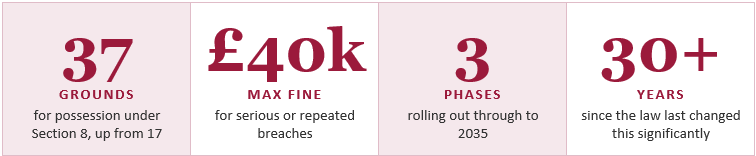
This is where the Act makes the biggest practical difference for landlords. Without Section 21, every possession claim must be made under Section 8, citing a specific ground. There are 37 grounds — up from 17 — and each has its own notice period, its own prescribed form, and its own requirements.
Here is the most important thing to understand about Section 8: procedure matters absolutely. The right ground, the right form, the right notice period, served in the right way. Any error — any — makes the notice void. You start again from scratch, often months later, with the tenant now aware that you are trying to move against them.
The grounds you’re most likely to need
- Selling: Ground 1A (selling the property) — 4 months’ notice. The property must be genuinely going on the market. Cannot be used in the first 12 months of the tenancy. A 12-month re-letting restriction applies after use.
- Moving back in: Ground 1 (landlord or family moving in) — 4 months’ notice. Cannot be used in the first 12 months. Same 12-month re-letting restriction. Family covers you, siblings, parents, grandparents, children and grandchildren.
- Rent arrears: Ground 8 (mandatory arrears) — 4 weeks’ notice, but only once 3 months of arrears have accumulated. Once proven, the court must grant possession — but with 28-week average court delays, total exposure can exceed 12 months’ rent.
- Persistent arrears: Ground 11 (persistent arrears) — New ground. Pattern of late payment — not necessarily consecutive. Missing one month isn’t persistent; missing three over a period of time is.
- Anti-social behaviour: Ground 14 (anti-social behaviour) — Now immediate. From the moment the notice is served you can start proceedings. Requires documented evidence — incident logs, police reports, neighbour statements.
Important note on Grounds 1 and 1A: before you issue either of these notices, have a conversation with your tenant. A negotiated exit, including, potentially, a financial incentive to leave, is almost always preferable to a formal notice. Once you serve, you’re committed to a 4-month timeline, potential court proceedings, and a 12-month re-letting ban. Think it through carefully first.
Rent increases — Section 13 is the only route
From today, there is only one lawful way to increase the rent. Section 13, using the prescribed Form 4A, with a minimum of 2 months’ written notice. Any rent review clause in your existing tenancy agreement — RPI-linked, percentage-based, anything, is now void. It has no legal effect.
Tenants can challenge a Section 13 notice at the First-tier Tribunal completely free of charge. And here’s the part that catches landlords out: if they do challenge, the new rent doesn’t take effect from the date your notice expires. It takes effect from the date of the tribunal’s decision, which can be months away.
You must support any rent increase with genuine comparable evidence, recent lettings of similar properties in the area. Index-linked formulas and portfolio-wide percentages will not hold up at tribunal.
A practical tip: when you serve your Section 13 notice , say you’re increasing from £1,000 to £1,100 — consider sending a separate letter at the same time offering to agree a slightly lower figure (say £1,057) by mutual written agreement. If the tenant accepts that separate agreement, the tribunal process falls away entirely and the increase takes effect immediately. It needs to be a genuine, meaningful offer — not just a pound less — but it’s a useful tool that removes the incentive to challenge.
The real cost of a bad tenancy under the new rules
This is the arithmetic that landlords often don’t work through properly. Here’s what a realistic arrears case looks like under the new regime:
- Month 1: Tenant stops paying. You cannot serve a Section 8 notice yet — you must wait for 3 months of arrears to accumulate.
- Months 1–3: You continue providing the property. Your mortgage, service charges and management costs continue to run. You cannot change the locks.
- Month 3: Three months of arrears reached. You serve the Section 8 notice. Four-week notice period. If the tenant doesn’t leave, you issue court proceedings.
- Months 4–11: Average time from issuing a claim to repossession by bailiff — 28 weeks. There are only 200 enforcement bailiffs in England and Wales.
- Month 12–15: Possession achieved. On a £2,000/month property: rent loss of £24,000–£30,000. Before legal costs.
This is not a worst case. This is the realistic arithmetic of a standard arrears case under the new system. Without rent guarantee and legal expenses insurance, this is an entirely uninsured loss against your portfolio.
This is why referencing matters more than ever. And why rent guarantee and legal expenses insurance — which is now included in our Premium and Value Managed packages for new tenancies — is not a nice-to-have. Under this regime, it’s essential.
Enforcement — it’s more serious than before
The Act places a new statutory duty on local councils to enforce landlord legislation. Previously discretionary — now a legal obligation. Councils fund their enforcement activity directly from the Civil Penalty Notices they issue. They are financially incentivised to find non-compliance. Government guidance explicitly asks them to be proactive, not reactive.

Rent Repayment Orders are one of the most underappreciated risks. A tenant — or former tenant — can apply to the First-tier Tribunal if a landlord has breached their obligations. It’s completely free for them to do. They can claim back up to 24 months of rent and can make that claim up to 2 years after the tenancy ends.
RPOs apply to landlords, managing agents, and the directors of limited companies. There is no hiding behind a corporate structure. No-win no-fee solicitors are already building practices around this area. Deposit protection claims from 2007 are still being pursued in 2026.
Ignorance is not a defence. It has never been a defence in English law and it is not one under this Act. Whether or not you knew about an obligation, non-compliance carries the same penalties.
10 things to do right now
These are not suggestions. These are the things that protect you.
- 1. Download the Government Information Sheet from GOV.UK and send it as a PDF attachment to every existing tenant before 31 May 2026. Not a link — the actual PDF. If you’re with Homefinders, we are doing this for you.
- 2. Check your deposits are correctly registered in an approved scheme. RPO claims from deposit failures are still being brought 19 years after the law came in.
- 3. If you want to increase the rent, use Form 4A and support it with genuine market comparable evidence. Your existing rent review clause is now void.
- 4. If a tenant makes a pet request, respond in writing within 28 days with a documented decision and reason.
- 5. Start a proper evidence file for every tenancy — every payment, every late payment, every repair request, every communication. This is your protection in court and against RPO claims.
- 6. Respond to every repair request in writing and document your timeline. This is your protection under Awaab’s Law once it comes into force.
- 7. If you’re considering serving a Ground 1 or 1A notice, speak to us first — or a solicitor. Once served, you’re committed to a 4-month timeline and a 12-month re-letting ban. There may be a better route.
- 8. Review your insurance. Rent guarantee and legal expenses insurance is not optional under this regime — it’s your financial safety net. Check what you have in place.
- 9. Register on the PRS Database when it launches in late 2026. It will be compulsory, and failure to register can affect your ability to use certain possession grounds.
- 10. Talk to us. Genuinely. If you’re not sure whether you’re compliant, or if you’re worried about a specific tenancy, please reach out. That’s what we’re here for.
What Homefinders is doing for our landlords
We’ve been preparing for this for a long time. Here’s what we’re doing for every managed landlord:
- Serving the Government Information Sheet on all existing tenants by 31 May 2026 — automatically, as standard
- Updating all tenancy agreements to the new Assured Periodic Tenancy format
- Handling all Section 13 rent increase notices with market comparable evidence prepared and retained
- Managing all tenant selection with documented, legally defensible decision-making
- Preparing and serving Section 8 notices correctly — right form, right ground, right service method
- Maintaining all Gas Safety Certificates, EICRs, EPCs and compliance documentation
- Responding to repair requests promptly, in writing, with a documented timeline
- Handling PRS Database registration when it launches
- Including rent guarantee and legal expenses insurance for new tenancies across our managed packages
We’ve also updated our management packages to reflect the new landscape — with more inspections, extended insurance periods, and no change to your management fee. If you’d like to talk through what your specific package includes, please do get in touch.
The landlords who come through this legislation confidently will be the ones who had the right habits in place — and the right people around them. We are here for that.
Have a question? We’d love to talk.
Whether it’s about your specific tenancy, what the Act means for your portfolio, or just a general chat about where things are heading — we’re always happy to talk. Book a free call with us directly below.
📅 Book a free advice call with Homefinders
🌐 www.homefinders.net · 📞 020 8533 6461
This article is for general information only and does not constitute legal advice. For advice specific to your circumstances, please speak to a qualified solicitor. Homefinders works closely with Ashley Taylors Legal — contact us to arrange a consultation.